
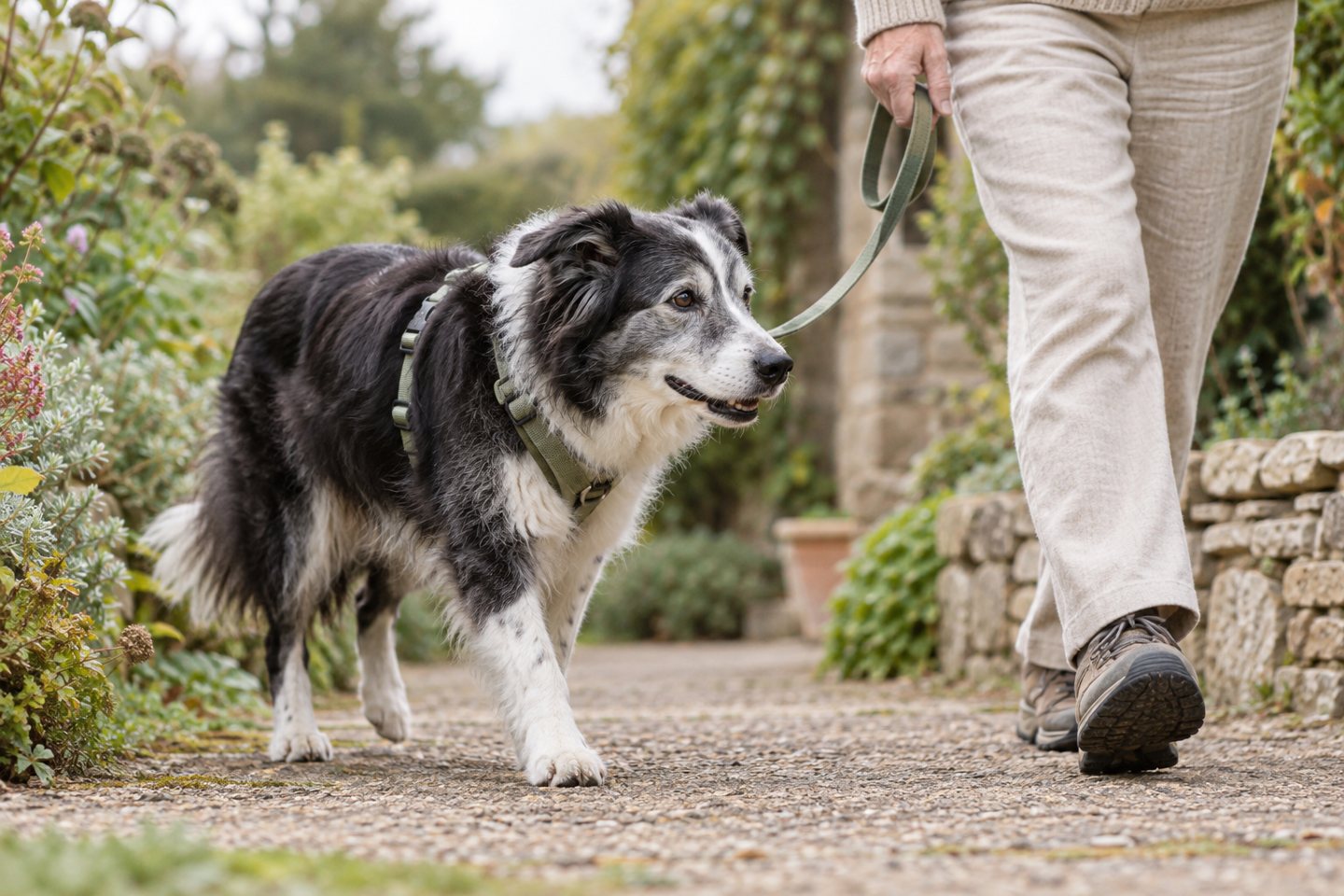
The change you may notice
Early changes can be easy to miss because they may appear as small shifts in a familiar routine. A dog may wake more at night, hesitate at a doorway, seem less responsive to a learned cue, have a toileting accident, or interact differently with family. These observations can fit the behavioral domains used to describe CCDS, but they can also have other causes.
What to observe
Look for a change from your dog’s own usual behavior. Write down what happened, when it began, how often it happens, and whether anything changed at the same time—such as a new medicine, a move, a different schedule, or a change in mobility. Describe observable details (“paced from 1:10 to 1:35 a.m.”) rather than a conclusion (“had dementia”).
Practical next steps
Changes to note include:
- getting lost or stuck in a familiar place;
- altered greeting, attention, or response to familiar people;
- a new sleep-wake pattern;
- accidents after a period of reliable house training;
- difficulty with familiar cues or routines;
- a marked increase or decrease in activity, pacing, or anxiety.
Talking with your veterinarian
Book a veterinary appointment for new, repeated, or worsening changes. Seek prompt advice if a change is sudden, severe, or accompanied by your dog seeming acutely unwell. Bring your notes and medication list. A caregiver log can make the history more useful, but it cannot identify the cause on its own.
Editorial note: Educational information. It does not diagnose CCDS or replace veterinary care. Discuss new or worsening changes with a veterinarian.
Sources
- Olby et al. (2026), CCDS Working Group guidelines, JAVMA
- North Carolina State University (2026), CCDS diagnostic and monitoring guidelines
- 2023 AAHA Senior Care Guidelines: Cognitive Dysfunction and Behavioral Anxiety
- Cornell Riney Canine Health Center: Cognitive Dysfunction Syndrome
Source check: October 2026. Not individually reviewed by a veterinarian.
A description is a good starting point.
Try three short lines: what happened, when it happened, and what you would like to ask. Use the words you would use to describe a moment to someone who was not there.
Example format: “At [time], in [place], I noticed [observable behavior]. It lasted [duration]. My question is [question].”
This is a writing prompt, not a test or a diagnostic checklist.