
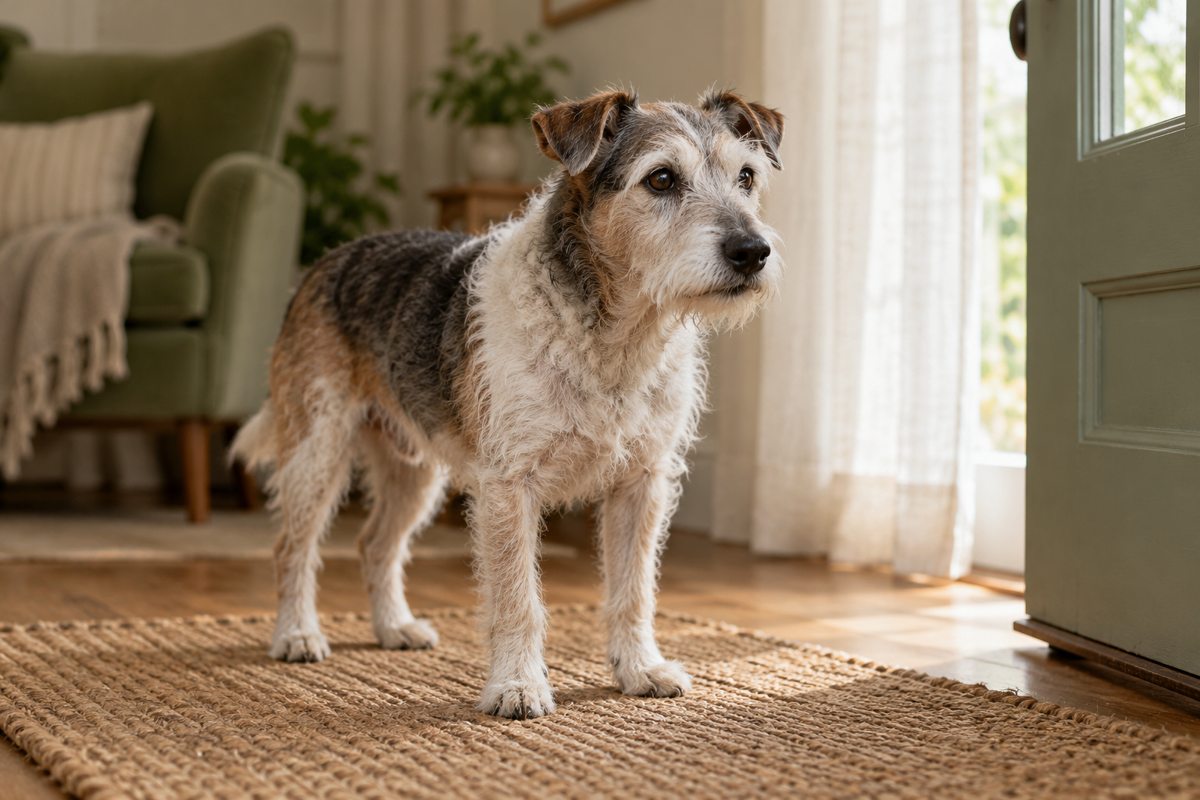
The change you may notice
An older dog may pause at the wrong side of a door, seem unsure in a familiar room, stare, or become stuck behind furniture. Disorientation is one behavior domain used when veterinarians assess possible CCDS. Similar observations can also relate to vision or hearing changes, pain or reduced mobility, neurological disease, or other health issues.
What to observe
If it happens, calmly help your dog reach a safe, familiar space. Do not startle, punish, or force them through a narrow path. Remove hazards they can reach and keep walkways predictable. These steps improve immediate safety; they do not treat or diagnose the underlying cause.
Practical next steps
Record the date and time, exact location, what happened immediately beforehand, how long it lasted, whether your dog responded to your voice or touch, and any other changes. A brief video may help your veterinarian if recording does not delay assistance or put anyone at risk.
Talking with your veterinarian
Arrange a veterinary appointment for new, repeated, or worsening episodes. Contact a veterinary service promptly if confusion begins suddenly, is severe, or occurs with other acute signs. The examination may consider sensory, orthopedic, neurological, and general health factors before cognitive dysfunction is considered.
Editorial note: Educational information. It does not diagnose CCDS or replace veterinary care. Discuss new or worsening changes with a veterinarian.
Sources
- Olby et al. (2026), CCDS Working Group guidelines, JAVMA
- North Carolina State University (2026), CCDS diagnostic and monitoring guidelines
- 2023 AAHA Senior Care Guidelines: Cognitive Dysfunction and Behavioral Anxiety
- Cornell Riney Canine Health Center: Cognitive Dysfunction Syndrome
Source check: October 2026. Not individually reviewed by a veterinarian.
A description is a good starting point.
Try three short lines: what happened, when it happened, and what you would like to ask. Use the words you would use to describe a moment to someone who was not there.
Example format: “At [time], in [place], I noticed [observable behavior]. It lasted [duration]. My question is [question].”
This is a writing prompt, not a test or a diagnostic checklist.