
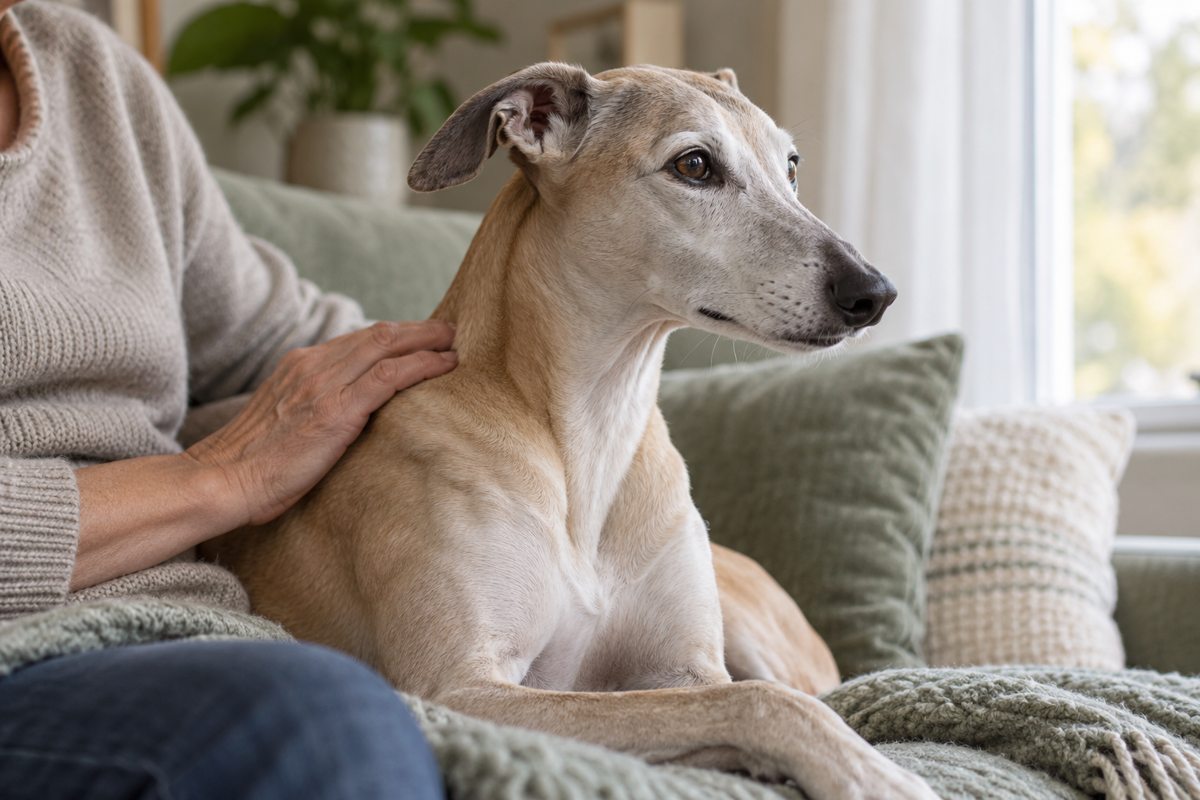
The change you may notice
Older dogs may change in their activity, sleep, mobility, senses, and daily routines. There is no online checklist that can reliably sort a particular change into “normal aging” or CCDS. The important comparison is with your dog’s baseline and with the timing, frequency, and impact of the change.
| Observation | Helpful context to record | Why discuss it with a vet |
|---|---|---|
| More night waking | When it began; pacing, vocalizing, toileting, discomfort | Sleep disruption can have several causes |
| Getting stuck or seeming lost | Location, time, what helped, whether it is new | Disorientation is one possible cognitive domain, but not specific to CCDS |
| Indoor accidents | Urine or stool, frequency, thirst, routine, mobility | Medical, mobility, and learned-routine factors may overlap |
| Different social response | Who/what was involved, hearing/vision context, onset | Sensory, painful, medical, or cognitive changes may affect interaction |
| Less activity or more pacing | Duration, mobility, rest, medications, environment | Pain and other health changes can affect activity and behavior |
What to observe
Gradual change does not automatically mean “just old age.” New, repeated, or progressing behavior deserves a conversation, particularly when it affects comfort, sleep, toileting, or safety. A veterinarian can review the whole health picture, examine your dog, and decide what tests are appropriate.
Practical next steps
If the change is sudden or severe, contact a veterinary service promptly. Otherwise, write down concrete examples and arrange an appointment. The Change Log is designed to organize observations, not calculate a diagnosis.
Talking with your veterinarian
Editorial note: Educational information. It does not diagnose CCDS or replace veterinary care. Discuss new or worsening changes with a veterinarian.
Sources
- Olby et al. (2026), CCDS Working Group guidelines, JAVMA
- North Carolina State University (2026), CCDS diagnostic and monitoring guidelines
- 2023 AAHA Senior Care Guidelines: Cognitive Dysfunction and Behavioral Anxiety
- Cornell Riney Canine Health Center: Cognitive Dysfunction Syndrome
Source check: October 2026. Not individually reviewed by a veterinarian.
A description is a good starting point.
Try three short lines: what happened, when it happened, and what you would like to ask. Use the words you would use to describe a moment to someone who was not there.
Example format: “At [time], in [place], I noticed [observable behavior]. It lasted [duration]. My question is [question].”
This is a writing prompt, not a test or a diagnostic checklist.